Pages

Showing posts with label Livestock. Show all posts

Thursday, August 28, 2014

Ducks in the Suburbs


I can never decide what to call our property...We live within the city limits, so we could be considered a "city mico-farm" or "urban homestead." But people growing produce and raising chickens on 4,000 square foot lots in the city would laugh at that - we live on over half an acre that hardly looks like the city.
 
Being such a small city, our property seems quite suburban even though it is in the city. We are on a street with picket fences and large yards, half a mile from major shopping. 

What makes our neighborhood fantastic and unique is that despite being two miles from downtown, we are zoned semi-rural and are therefore zoned for livestock and have very few restrictions on the management of our property. So we have quite a bit in common with the "country" as well!

All to say, I don't know what label to give our little homestead endeavor. For the purposes of this post I'm going with "suburban", since we have a large yard, but close neighbors, our two main considerations for keeping livestock.


We've had our four Welsh Harlequin ducks for about six weeks. I love them! They are beautiful, fun to watch, and becoming very friendly. I started sitting out in the yard and tossing them their food from my hand, so now they come running when I call them (I make a clucking sound like I make to get horses to move forward...old habit, new context!) and follow me around the yard.

So far, no eggs. We are disappointed, but not surprised. The move from their former home stressed them into molting. Over the first four weeks they were here they started losing their feathers and replacing them with new ones. This new growth takes a lot if energy, so molting birds tend to shut down egg production for 4-6 weeks, from what I've learned.
Now we are heading into fall, and days are getting shorter, so if we want eggs before next spring we need to artificially lengthen their expose to light. Right now, naturally our daylight is about 14 hours long. We will incrementally increase their light by 30 minutes every few days to get them to 17 hours per day. This increase should stimulate their hormones and send them into egg production. We hope!

We still need to install a permanent light fixture in their house ( which will require drilling a hole through our garage wall) so right now I am improvising by hanging a flashlight in their house at night for the needed extra light hours. Not ideal, but it should work for now. 

Keeping ducks in the suburbs poses a few more challenging issues than chickens.  The most obvious is their  need for large amounts of water.  Even if you do not provide swimming and bathing water, they still drink a LOT and need to be able to put their entire bills into the water, so a regular, very shallow chicken waterer will not work. We use a large tupperware storage container with two large holes cut into the lid.  The ducks can get the entire heads in the water, but cannot climb in or splash the water creating a mess in the pen.  We also do provide the ducks with a tub for swimming, which stays in the yard (not in their run or house) and is dumped, moved, and refilled everyday so no muddy areas are created.  One or two ducks can fit in at a time and they are lovely and fun to watch splash and dunk their heads under.  

Because ducks drink so much water, they poop a lot.  I can't compare the amount to chickens, since I have never kept chickens, but from what I read it is more and more watery.  Makes sense.  If you have a small or average sized suburban yard and let them free range, your yard will eventually be covered in duck poop unless you have a plan to manage it.  Out of deference for your neighbors - please do!  We have a large yard, so I did not think duck poop would be a big problem.  However, I did not consider that they might choose one spot of the yard as their territory and stay there.  But that's exactly what happened.  On the half acre they have access to, they spend 90% of their time on a patch of lawn that is about 15' by 10'.  I'll talk about how I maintain it in a minute.  Don't forget that like any poultry, their enclosure and house/coop will require regular cleaning or a deep litter method (that could be a separate blog post).  

Those are the only "downsides" I can think of and ducks have plenty of benefits, which is why we keep them! 

Unlike chickens, they do not scratch, so our garden beds, grass, and mulch are not dug up and strewn around.  They webbed feet are very gentle on the ground.

Laying breeds, like ours, lay lots and lots of eggs.  Good Welsh Harlequins can lay more eggs per year than even the BEST egg-laying chicken breeds!  It is only their need for water and space that keep these amazing birds out of commercial egg production - not their egg laying ability.  

Their manure is watery, which make it very easy to clean up with a hose.  My cleaning routine is below. 

The ducks we are keeping, Welsh Harlequins, and other breeds, are excellent foragers.  They can get a good amount of their dietary needs met through foraging for larvae, slugs, snail, grass, weeds, and other tidbits.  They will eat fish, frogs, and I hear even mice, if the opportunity presents itself! 

They love the water, of course, so we do not overly worry about keeping them and their area dry.  With chickens and with our quail, you must make sure that the birds' feet sty dry or health problems can ensue.  The ducks, on the other hand, run outside on wet days and literally dance in the rain and wash themselves under the water pouring out of our gutter spouts.   They love it.  Their hardiness in poor weather is one less thing to worry about.

My schedule for managing the ducks probably looks different than it would if we were on several acres.  But here I we do it :

I let them out of their house (where they are fully enclosed overnight) at 7am.  Give them their layer feed. They have access to a sandy run that is about 3' X 6'.  I usually open that gate also and let them out into the yard in the morning.

I spray out their waterer and refill it with fresh water.

I fill their pond.

I spray the grass where they spend most of the time and the watery poop just dissolves away into the soil.  If the manure has dried too much or the yard is covered in feathers (likewhen they were in molt) I rake the spot of yard they favor and scoop up the piles of feathers and manure and move it to the compost bin.

In addition to spot cleaning when needed, I rake this area of the yard every week on Friday morning so that when the neighbors are home and out in their yard over the weekend the area is nice and clean. On Friday I also pick out their house (which is a large walk-in shed attached to our garage) and the sandy run with a pitchfork, like you would clean a horse stall.  I scoop out the wet bedding, pick out the manure, and try to leave all the clean shavings I can in place to save money.  I add new shavings when needed.

In the afternoon, since we are home I have the boys help me pick some big dandelion leaves and some overgrown lettuce from the garden. We shred it up and sprinkle it over the top of their pond water.  The ducks LOVE to dabble for this, and we sit and enjoy watching them.

In the evening around our dinner time either my five-year-old or I go out to give the ducks their dinner.  They get another big scoop of feed.  This time we usually sit in the grass and toss it to them by hand.  This has worked wonders in helping them become friendly and confident around us.  Sometimes they are too pushy, and have tried to nab the food out of my son's hand, so he carries a stick with him now to push them back if they get in his face.

At 8pm when it is getting dark I go out and dump their pond water so it doesn't attract mosquitoes over night.  Plus it is usually at least a little dirty. I move their waterer into their house so they can have it overnight, but take the feed dish away and lock it in the feed room so it doesn't bring hungry rats or raccoons to the duck and quail pens.

I close the ducks up in their house, right now with a flashlight hanging in the rafters for their extra "daylight" hours.  This won't always be the case, since we are working on an automatic timing system that will turn on a light at dusk and off after they have met their 17 hours light requirement.

So for now I have to go back out at 10pm and take the flashlight down.

That's life with ducks in the suburbs!  It could be more streamlined, but I really enjoy spending time around them, so i don't mind one bit!  They are worth the work for their beauty and entertainment value, but we are certainly looking forward to the day we are getting fresh eggs and eventually hatching out beautiful little Welsh Harlequin babies!

Questions about ducks or suburban homesteading?  Leave a comment!


Friday, July 11, 2014

Our New Backyard Beauties: Welsh Harlequin Ducks

I am so excited to share pictures of our new livestock/pets/lawn ornaments!  (They are very shy right now, understandably, so I'll have nicer pictures in a week or so).

We took a little roadtrip 40 miles south to Conway, Washington to purchase a small breeding flock of Welsh Harlequin ducks. Yes - I said breeding flock!

Welsh Harlequins are an endangered breed of domesticated duck listed as "critical" by the Livestock Conservancy. I figured, if we want eggs and are already buying several females, why not go all the way and get a drake too?  This breed does fairly well with brooding (sitting on their eggs to hatch them- some domestic birds, like my quail,won't) and natural mothering, so if I create the right conditions I hope they will hatch and raise their own young.  I love the idea of contributing to a conservation effort and helping to preserve genetic diversity among domestic ducks.

And aren't they BEAUTIFUL!!

More about the ducks later... I'm sitting outside by their pen typing this on my phone. I just couldn't wait to share pictures!

Peace, love, and ducks,
Lauren


Our Newest Pen is Finished

We finished work on our newest pen this morning, and we're picking up the residents in a few hours! We are lucky to have been able to build/assemble this almost entirely out of things we already had: the shed attached to our garage, an animal pen I've had for years, bricks and a piece of plywood from around the house and yard, and I made a waterer out of an old plastic storage tub (picture coming later). The only newly purchased items were sand (and I still need a ton more) and the plastic edging.

What do you think is coming to the homestead?

Check back later!!
Lauren

Monday, June 30, 2014

Quail Update

Brown/wild-type quail
The quail chicks we brought home at 4 days old have now been with us for two weeks.  They've gone from tiny, fluffy chicks to almost adult birds in such a short time.  They now have mostly adult feathers and look like small versions of their full-grown counterparts. 

They've already been upgraded to a new home, since by the end of the first week their brooder was getting too cramped.  By two weeks old they were testing out their wings, so I had to add a wire cover.  

They still have their heat lamp, but I have been gradually raising its height.  Now that they have their feathers in, they shouldn't need it much longer.  The days are also getting warmer, so I will start turning it on only for the night. 

This was my first experience with chicks and a brooder, so I learned quite a lot (and I'm sure I'm not done!).  

1) Chicks are MESSY!  
2) They grow so fast
3) You better be prepared to move them into larger and larger quarters
4) They will find ways to spill their water
5) They will poop in their water and food every chance they get
6) They are practically born with a full range of adult behaviors (preening, dust bathing, pecking, scratching...)

Some things I changed as I went along:

1) Switched to pine shavings.  A website I read advocated paper towels for the floor of the brooder.  He said he cleaned them every few days.  WHAT!?!  I tried that and changed them out three times a day for the first few days.  It was insane.  Every time they got wet it spread through the entire floor.  The birds were constantly on wet ground.  Disgusting and unhealthy.  A deep layer of shavings effectively keeps them clean and every other day I can add new shavings on top, then clean it all out when needed.  For a while, as I was digging out my garden bed, I even gave them pieces of sod.  They loved it!  They explored the tall blades, pecked at them, and found the occasional insect.  
  

2) I moved them to a larger brooder after two weeks.  I could have started with the larger one in the first place.  Now I know!

3) After switching to shavings I had a problem with the water seeping out into the shavings, and recreating the paper towel problem.  When shavings get kicked up into the waterer it soaks up all the water - the chicks can't drink and the floor gets soggy.  So I put the waterer up on a brick.  They have to take a step up, and most of the shavings stay down.  Everyone stays clean. 

4) The birds are not discriminate about where they poop - not that I thought they would be, but that means I had to set up their brooder to keep things as clean as possible.  One DUH mistake I made at first was putting the feeder too close to the waterer.  When the birds were eating, they would poop with their bottoms right over the water... OOPS!  Figured that out quick and made sure they had enough distance between them!!  

5) It is amazing how much behavior the birds are born with.  When I added shavings they immediately freaked out and starting dust bathing!  It is adorable!!  They fluff out their feathers and shake their whole bodies to get the shavings running through their feathers.  I don't think shavings will really help them clean themselves like sand or loose dirt, but it still allowed them to express this natural behavior (they will have a sand box for bathing in their outdoor pen when they graduate up!).  They also began scratching and pecking through it like maniacs.  It was like watching someone whose hands have been tied behind their backs finally get to scratch that itch!  Watching them made me grieve for the millions of intensively housed birds raised on wire mesh floors who never, ever get to dust bathe, scratch, or flap their wings.  They are not fully birds without those basic bird needs being met. 

6) I added sticks, a "log" (big stick) for them to hide under, and hanging greens.  They interactive environment stimulates all their birdy instincts, gives them something to do, and keeps them active. Enjoy some pictures of their set up!

Exploring their sticks (collected by the boys).  A natural and stimulating environment is important for health.  Bored birds can develop abnormal behavior, including feather plucking, fighting, and even cannabalism. 
You can see the blurry head as one pecks at the hanging lettuce leaf.  This offers a nutritional boost as well as stimulating entertainment and exercise. 
You can see two color varieties here: the one center top with its eye on the camera is the wild-type brown, while to the back and slightly left is the tuxedo, with dark brown feathers and a white chest.  The one on the sticks is also a tuxedo, from the dark feathers and bit of white you can see near the eyes and chest.  

Tuesday, June 17, 2014

Welcome, quail chicks!

Today we picked up 16 four-day-old quail chicks! They are settling into their brooders. My boys absolutely love them. Hopefully half or more will be females and we will keep them to lay eggs. The males... well, we'll talk about that later when they're not quite so adorable.


Sunday, June 15, 2014

Big Homestead Project - Fencing

Our fence needs a little work, huh?

This is our big project year.

White four board fencing is beautiful, but not when all the posts are rotten and it's falling over into the grass - and this picture was taken after the kind neighbor staked up the parts that were literally at 45 degree angles to the ground and held up by ropes and support beams!  When the former owner of the property installed this, he didn't anchor the posts in cement; they are buried in the dirt in a city that gets something like 250 days of rain a year!  It's not going to last very long!

(you might be an urban farmer if you look at this picture and don't see "weeds" - you see "forage," i.e goat food!)
The whole fence on one side of our property and along the back is coming down and getting replaced with a six-foot tall privacy fence.  We are so fortunate that our neighbor on that side is a contractor and is willing to build it and split the cost with us.

A privacy fence doesn't seem very homestead-y, but it solves a large number of problems for an urban or suburban homestead:

1.  A privacy fence will be secure.  Dogs won't be able to get on our property, livestock won't be able to get off.  Racoons can climb and hawks can fly, but from what I've read, almost all livestock losses are due to free roaming dogs.

2. The neighbor's Jack Russell terrier (hopefully) won't bark at our livestock (and us, and our dog, and our hose) all day if he can't see us.  He also (probably) won't be able or motivated to dig under a sturdy, well installed privacy fence.

3. On the flip side, our animals hopefully will not bark/cluck/quack/baa/bleat (or whatever) at the neighbors whenever they get home or come outside.

4. The sights, sounds, and smells of our homestead will be more obstructed from our neighbors.  Of course we plan to keep a very well-managed, clean, and tidy mini farm, but it can only help to have a little extra privacy to ensure the neighbor's good will.  If they want to come over and visit they can, but if they don't, they don't have to feel like they live next to a funny farm all the time.

5.  I feel pretty weird about the neighbors watching me pick lettuce or feed quail in my pajamas in the morning while they're drinking their coffee and getting their kids off to school... so a little privacy will be nice for me and probably help limit the level of insanity they perceive over here.

6.  When it comes time for unpleasant tasks (raking out deep litter in the poultry pens or slaughtering meat animals) or just ridiculous tasks (like chasing a loose quail around the yard in my bath robe), I won't have an audience and the neighbors won't have to see anything they don't want to see. 

So should every suburban homestead build a privacy fence right from the get-go?  No - I wouldn't say that, unless that is fully within your budget and would make you feel more comfortable with your farming venture.  But if the opportunity to build a new fence arises, give a tall, solid fence careful thought, it may be worth the money and effort.    
  

Wednesday, June 4, 2014

Comparing Homestead Poultry

From Storey's Guide to Raising Ducks.

I was already pretty set on raising ducks and quail on our little homestead, but this chart helped solidify that decision.

Ducks seem to be the obvious choice for our very rainy climate and the accompanying slugs and snails.

I raised quail in Kentucky because they slid under the HOA ban list (technically they are "game birds" not the banned "poultry" and fit in a pen so small no one noticed). I loved them for their beautiful little sounds, pretty feathers, easy keeping, and delicious and decorative eggs.

A breeding trio of heritage ducks and an aviary full of coturnix quail are on my wish list for next year!


Thursday, April 24, 2014

Livestock for Small Spaces - Coturnix Quail


When we lived in Kentucky our house was in the suburbs on 1/4 acre.  We chose the house mainly for the lot!  It was large for the area and backed up to a tree line.  It was a little bit of privacy in the otherwise fairly barren and exposed cookie cutter suburban development.

We had an HOA which did next to nothing (except charge us money and plant flowers at the neighborhood entrance), but said that we could not have poultry on our property.  I was adamant about raising my own birds for eggs since I had long ago given up eating factory-farmed animal products.  I simply hadn't eaten eggs in years!  So I found a way around the rule:  quail.    Technically not "poultry," quail are classified as "game birds."  They are small, quiet, attractive, and not as messy as larger birds.  Needing only about 1 sq ft per bird, you can easily keep a small flock in your backyard.  Coturnix quail are the type usually used for eggs and for meat.  They are about the size of a large robin and lay amazingly large eggs given their body size.


Need another reason to raise quail (even if you can have chickens?).  Quail are excellent feed converters!   Chickens need roughly 3 pounds of food to lay 1 pound of eggs (a 3:1 feed conversion ratio) while Coturnix quail need only 2lbs of food per 1 lb eggs (2:1).  These little birds are a must-have for the urban or suburban homesteader who is ready to take on the responsibility and work of small livestock!


We got 10 female quail from a local urban farmer and kept them in a pen which was comprised of a coop and a run open to the grass.  In all, the set up was about 12 sq ft.

Inside the run. The birds loved exploring the tall grass.
     In the beginning I cleaned out the coop every few days and moved the entire set up every day.  But I quickly learned that with 10 birds, even once a day was not enough.  I also learned that quail dig.  Nice little round bird-sized holes. Perfect for twisting your ankle in.

So after a few months of time on grass, just as fall was setting in, we transitioned to a permanent location in between the strawberry patch and vegetable garden.  I started using a "deep litter" method, where fresh straw is layered in every day or as often as needed, while the previous days straw is left underneath.  This is a perfect solution for winter  The deep layer of straw with composting manure generates heat and keeps the birds warm, while the top layer is always clean for nestling down and laying eggs.  We did this in the run as well, since the grass was gone after a few days of a permanent location.

We are looking into getting quail for the new homestead soon.  We may start with chicks this time (we bought 4 week old birds last year) in a brooder, perhaps in the garage.

I'm thinking about building a permanent aviary instead of a tractor type run.  Both set ups have their advantages and disadvantages.  The coop/tractor gives them access to fresh grass.  But it can be very hard to move without injuring a bird (as I learned) or yourself (if you have a back back and knees like I do).  It also exposes all your grass to digging and copious amounts of bird poop - which will fertilize your grass, but also kill some of it, unless you want to move it twice a day.  Depending on how much space you have and what else you use your yard for, this may be a great option.  But in Kentucky we found that we were creating chaos in our relatively small yard and making it difficult for the kids to play.  Not to mention our hound-mix dog, Hudson, loved to roll in the really stinky grass after we moved the pen - yuck!!  

A permanent aviary could afford the birds even more space (since I wouldn't have to move it), and provide branches for hiding and perching and stimulation. It could be tall enough to clean out without bending over.  As long as the birds are constantly given greens, grass, weeds, and kitchen scraps (I found that mine especially loved cantaloupe rinds, pecking out every last bit of fruit) in addition to their pelleted food their diet should not suffer because they are not actually on grass.  The soiled straw could be composted immediately after being taken out with a pitchfork on a regular basis, or could be left in per the deep litter method and removed for the garden several times a year.  

I'll share some more lessons we learned from our first flock of quail and an update on a new flock later! 

In quail keeping as in all things,

Soli deo gloria
Lauren

The Beginning of a Homestead

How we got here...


I started looking at real estate online months before we moved to Bellingham, Washington.  I started looking as soon as Nate even thought about applying for the new job!  I guess I am just a perennial homemaker – always thinking, dreaming, planning, and learning about how I could turn a property into a home - my home.  I looked at little houses, big houses, old houses, new houses.  Some out in the country, some right downtown. 

If you’re like me, and your heart is in the country while your life has to be in the city or suburbs, looking at houses can be a heart ache.  I came across BEAUTIFUL turn-of-the-century farmhouses on several acres.  White porches, red barns, four-board fencing… an hour away from town.... and $50K over budget.  And I saw houses right outside town in the suburbs.  Newly built, granite counter tops, walk in closets, luxurious master bathrooms, beautiful backsplashes... and not a single feature that inspired me to actually go look at them.  They sat on teeny tiny lots with the compulsory ornamental tree and a few boxwoods in the front and a perfect square of lawn hedged in by four or five neighbors’ houses in the back.   Stifling.  

I tried to like them.  I really did.  I thought, “Well, maybe this one since there is a park down the street.”  Or “Maybe I’ll like being inside this house so much I won’t mind what is outside.”  Some of the kitchens were tempting.  I have always wanted a big kitchen.  A HUGE kitchen.  Somewhere to roll out pie and pizza doughs, to make breads from scratch, and host large gatherings.  Space to roast my Thanksgiving turkey and still have the pumpkin pie finishing, with green beans, glazed carrots, and stuffing on the range. 

But, as I tried to imagine living in one of these cookie-cutter American dream homes on a little manicured lot in suburbia I realized that all the appeal of these “chefs kitchens” with granite and double ovens and stainless steel was completely lost on me without the property to grow my own food and the space to live and play outside.  

A kitchen counter is a place to spread out the bounty of the morning’s harvest from your garden.  A stove top is where you splatter homegrown tomato sauce and fill a cast iron skillet with backyard quail eggs and freshly picked veggies for an omelet.  A pantry should be full of root vegetables, freshly dug in the fall.  A fridge should be bursting with brilliant greens: chard, lettuce, arugula, green beans, cucumbers.  

Eggs from our backyard quail in Kentucky
And an HOA telling me I can't have quail or grow tomatoes in my front yard?  No Thanks!!  So we passed on all the new-build neighborhoods with reasonable prices and told our realtor “charming older home on property, near town, quirks ok.”

And we prayed!  I prayed that God would bring something onto the market where we could grow, play, dig, garden, raise animals, and explore in our own backyard.  I prayed for a place where Nate could ride his bike to work – his perpetual dream.  I prayed for a place near town so we could be involved in the community and access all the great things about our small, fun city.  I didn't think we could have location and property, but we held out hope.  

And God answered!     

We now have a 1940’s cottage-esque cape cod on .6 acres 2.5 miles from downtown and Nate’s work!  It is in an established and friendly neighborhood with all older homes on large lots – most between ½ and 1 acre.   It has all the convenience of being close to downtown and tons of shopping (i.e. there is a Starbucks 1.2 miles in every direction, four grocery stores within 1.5 miles, and the mall - not that I ever go to malls - is 1.5 miles away) but the immediate area gives you the feel of a small country town with picket fences and chickens meandering down the sidewalks.    There is a park down the street that connects to a walking trail  that takes you one mile to a public beach on Bellingham Bay!

It has its quirks as an older home.  It’s smaller than the house we had in Kentucky, even though our family will only be getting bigger.  The dining room is literally a room.  With a door.  Not attached to the kitchen.  And the kitchen is in the back of the house quite separate from everything else.  That’ll take some getting used to.  All the rooms are pretty closed off… a far cry from our newer very open floor plan home in Kentucky. There is one full bathroom, and then a little “water closet” attached to the master bedroom (which is very tiny).  Walk in closets? Not a chance.  (Actually the closet situation sort of makes me have a panic attack so we’ll talk about that later. )  But the house and property just grabbed our hearts and imaginations right away!    And I love it.  

I love the white cabinets and bay window in the kitchen!  It is separate from the rest of the house, but it does have tons of cabinet space, a big sink, and cool built-in storage.
For now, we’re trying to make this smaller, older house into a functional home for our family.  With four bedrooms, a living room, and a den we have plenty of options.  There could be two bedrooms (a master and the boys sharing one), a guest room, and/or an office, and/or a play room.  Perhaps a library/study?   It has a basement that looks like it will be easy to finish.  A homeschool room?  A home gym?  A craft room?  Storage?   I'm sure it will evolve over time.  We have the feeling that the more closed off rooms will lead to more possibilities.  It will be easier to designate space for studying, for projects, for watching tv, for playing games, and for eating, etc than if it all existed in one large room. 

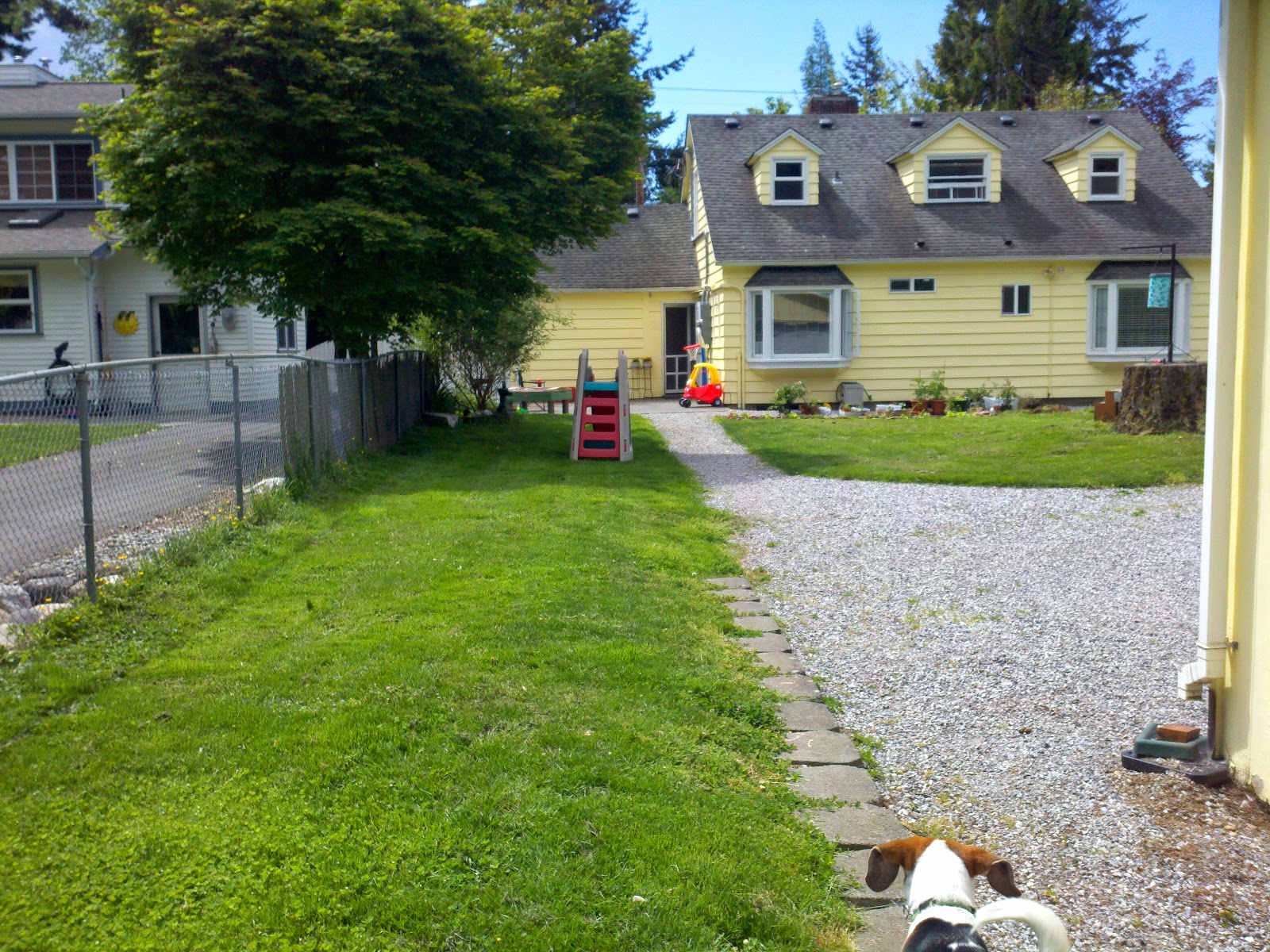
In between the house and the garage is what we call the "front backyard."  Behind the garage (shown here) is another 1/4 acre or so designated the "back backyard" lol

The yard goes way back behind the house, with plenty of room for a large vegetable garden, an herb garden, raspberries and blackberries on trellises, a strawberry bed, fruit trees, and of course a pen for quail.  My plan for next year is to get ducks.  They seem like the perfect fit for our wet weather and the constant barrage of slugs.  Eventually I’m even hoping for a dairy goat!  A huge garage sits behind the house with room for two cars and a shop.  Or a goat stall and milking parlour?  Or an indoor seedling growing area?  Or a chick brooder?  All three!?  


The "front backyard" between the garage and the house. I think from the street to the garage makes up about 1/4 acre.  From the garage back to the fenceline is a little more than 1/4 acre of grass and a few trees.  I love Hudson's ears flapping at the bottom of this picture!
The "front backyard" and the garage/shop taken from the second story window.  That odd-shaped patch of grass is destined to become 100% vegetable garden! There is too much gravel for my taste, but both our parents have or are getting RVs so it is a perfect set up for them to come stay. 

 So many possibilities!

This is the beginning of a suburban homestead.  Keep checking out the blog to follow along as I dream, design, plan, implement, mess up and try again in the home, the garden, and the farmyard!


In all things, to God be the glory
soli deo gloria
Lauren